The art of Insect Preservation for Display
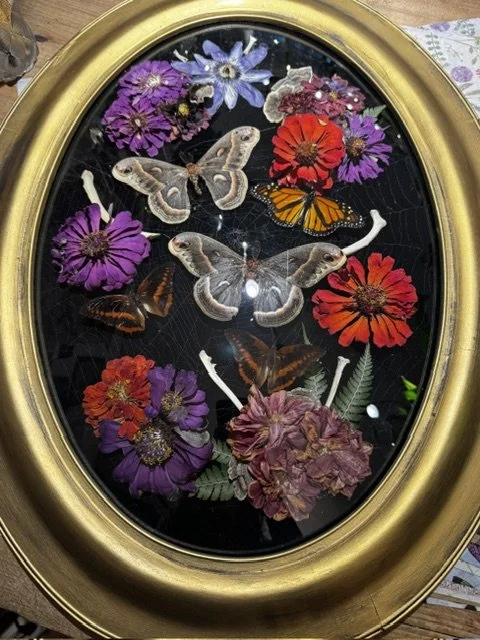
Responsibly sourced specimens laid in a vintage convex bubble glass frame with dried flowers, fungi and foraged animal bones. Background is a harvested spider web from the Two Gold Moons Gardens.
Insect preservation has existed for centuries, blending science, artistry, and a deep respect for the natural world. At Two Gold Moons, this tradition is carried forward with intention: honoring every specimen, teaching the skills behind the craft, and giving people a tangible connection to the quiet magic of the natural world.
But before we get into pinning boards and wing-setting rituals, let’s talk about the question everyone wants answered:
Where Do the Insects Come From?
Short answer: sustainably, carefully, and never from exploitative sources.
I work exclusively with reputable butterfly farms, conservatories, and local preservationists who prioritize ecological wellbeing. These places operate as conservation partners, raising insects through natural life cycles.
This matters, because the world of entomology is woven with nuance, and our vocabulary should reflect that.
Why I Prefer “Sustainable” Over “Ethical”
The term ethical gets thrown around online so much it’s nearly lost meaning. Even worse, it has unintentionally harmed the art and science of insect preservation by implying that any work involving insects must defend its morality before it can be appreciated.
In reality, responsible insect preservation has always been part of environmental stewardship. Farmers and conservatories breed butterflies for conservation, pollinator support, and educational initiatives. When specimens are preserved after they expire, we extend their story rather than erase it.
That's why I prefer the term sustainable.
It’s grounded. Accurate. Transparent.
It acknowledges the ecological cycles these insects are part of, and the way preservation can support—not exploit—those systems.
Inside a Two Gold Moons Preservation Workshop
This is where the magic really unfolds.
My workshops are designed for absolute beginners and for artists or collectors looking to deepen their craft. Every student receives a full kit that includes:
A butterfly or moth (arachnids and beetles too!) specimen
Professional entomology pins
A reusable pinning board
Tools for handling and manipulating delicate structures
A frame to display your final piece
Written informational to take home
But the real value is in the hands-on experience.
You’ll learn how to:
• Rehydrate a specimen (when needed)
• Properly handle fragile wings and bodies
• Use specific pinning techniques to achieve symmetry
• Prepare it for drying and long-term display
Students work step-by-step with me, learning how to transform a delicate creature into a piece of art that will last decades.
Why People Are Drawn to This Art
Because there’s nothing quite like holding something ephemeral and giving it permanence.
Because nature is the ultimate designer.
Because there’s beauty in preservation—not consumption.
Because it taps into a primal part of us that wants to understand, protect, and remember.
Whether you’re a plant lover, a collector, a naturalist, a witchy soul, or someone just curious about the process, this workshop is designed to meet you exactly where you are.
Ready to Create Your Own Artistic Display?
If your curiosity is sparked or your hands are itching to try something new, I’d love to have you join an upcoming class. Events fill quickly, and kits are limited for each session.
👉 Visit the Events page on the Two Gold Moons website and grab your ticket through Square.
Let your curiosity lead you.
And let a small piece of the natural world become part of your story.